Quick Key Takeaways – Outlet and Switch Installation
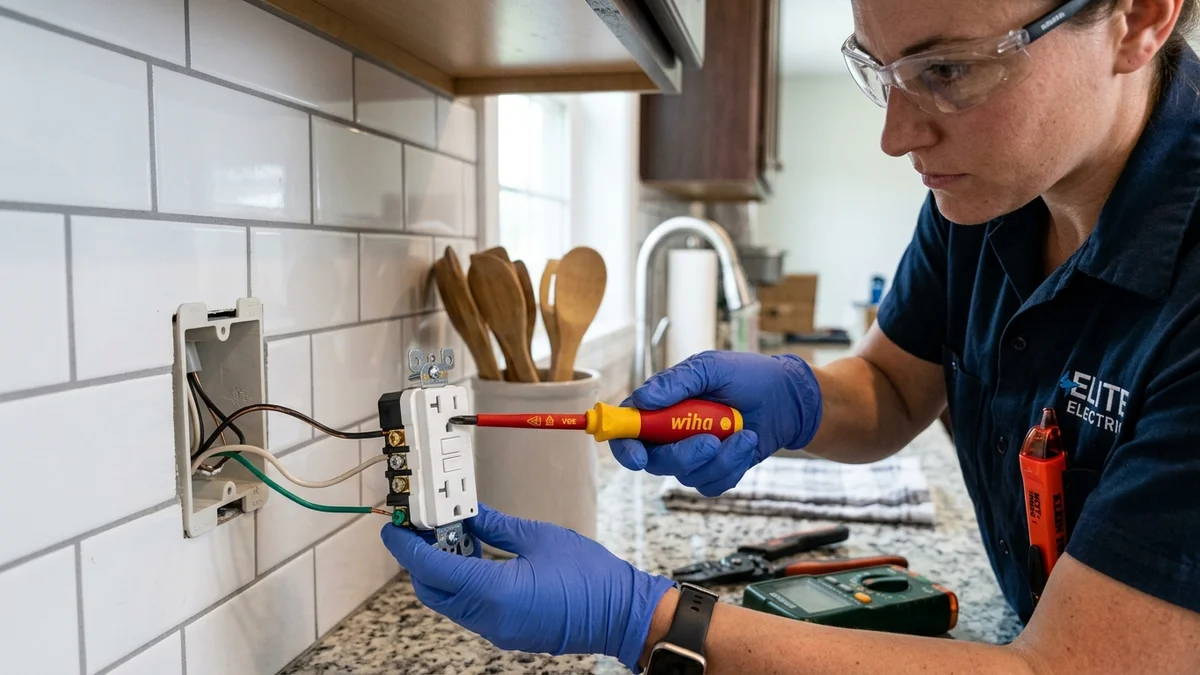
Professional Outlet Repair, Switch Wiring, and GFCI Safety Upgrades in Schenectady, NY
Electrical wall receptacles and switches are the most frequently used components of any building’s electrical distribution system. Every time you plug in a smartphone charger, start a kitchen blender, power a computer workstation, or flip a wall switch, mechanical tension and electrical current pass through device terminals. Over decades of repetitive use, internal brass contact blades loosen, spring tension weakens, terminal screws work loose due to thermal expansion, and older plastics become brittle.
In older Schenectady properties—particularly in historic neighborhoods like the Stockade, Bellevue, Mont Pleasant, and Woodlawn—thousands of residential homes still feature legacy, ungrounded two-prong receptacles. Plugs fit loosely into worn slots, and moisture-prone areas like kitchens, bathrooms, basements, and garages frequently lack mandatory Ground-Fault Circuit Interrupter (GFCI) protection.
Our regional dispatch network coordinates qualified, professional electrical contractors who specialize in comprehensive residential and commercial outlet and switch services throughout Schenectady, Niskayuna, Rotterdam, and Scotia-Glenville. Technicians troubleshoot dead outlets, convert ungrounded receptacles to code-compliant grounded configurations, install child-safe tamper-resistant outlets, and wire modern smart dimmers with transparent, upfront written estimates.
The Danger of Worn and Loose Electrical Receptacles
Many homeowners overlook loose wall outlets, assuming that as long as a plug stays in the slot with a slight wiggle, the connection is functional. In reality, a loose outlet is a serious fire hazard:
The Physics of Loose Receptacle Failure:
Worn Internal Contact Blades ---> Reduced Surface Contact Area ---> High Electrical Resistance ---> Intense Thermal Heat Generation ---> Melting Plastic Faceplate and Wall Cavity Fire
When an appliance draws high current through a loose outlet, the reduced contact area creates an electrical bottleneck. This resistance generates intense localized heat, often exceeding 300°F inside the enclosed junction box. Over time, wire insulation melts, plastic faceplates scorch, and adjacent wooden wall studs can ignite.
| Receptacle Warning Sign | Physical Hazard Present | Urgency Level | Recommended Corrective Action |
|---|---|---|---|
| Plugs Fall Out or Sag from Wall | Internal brass spring contact tension is completely fatigued | HIGH: Arcing risk under load | Replace with commercial-grade tamper-resistant receptacle |
| Burn Marks or Brown Scorching | Chronic localized resistance overheating; insulation melting | EXTREME: Imminent electrical fire | De-energize circuit breaker immediately; replace outlet and inspect wire |
| Warm or Hot Faceplate to Touch | Loose terminal screw or backstabbed wire connection | HIGH: Thermal stress on copper wire | Re-terminate using side screw terminals torqued to manufacturer spec |
| Outlet Sparks When Plug Inserted | Contact arcing as circuit attempts to bridge poor gap | MODERATE-HIGH: Damaged blades | Replace worn outlet; inspect appliance cord cap |
| Receptacle Has No Power (Dead Outlet) | Upstream GFCI tripped, broken neutral splice, backstab failure | MODERATE: Broken circuit continuity | Multimeter circuit trace and splice repair |
For general troubleshooting on non-functioning branch circuits, explore our comprehensive electrical repair services.
Types of Modern Receptacles Installed Across Schenectady
Upgrading your home’s devices enhances safety, convenience, and modern functionality. Technicians install a wide variety of specialized electrical receptacles:
| Receptacle Type | Unique Safety or Functional Feature | Mandatory Code Locations (NEC 2020) | Best Practical Application |
|---|---|---|---|
| Tamper-Resistant (TR) Outlets | Internal spring-loaded safety shutters prevent insertion of foreign objects (keys, paperclips) | Mandatory in all residential areas (NEC 406.12) | Every room in the home; protects children from electrical shocks |
| Ground-Fault Circuit Interrupters (GFCI) | Detects current leakage (4–6 milliamps) and cuts power in 1/40th of a second | Bathrooms, kitchens, basements, garages, exteriors, within 6 feet of sinks | Wet and moisture-prone areas; life-saving shock prevention |
| Arc-Fault Circuit Interrupters (AFCI) | Identifies dangerous low-level electrical arcing from damaged wires | Bedrooms, living rooms, hallways, closets (NEC 210.12) | Protects against electrical fires concealed inside wall framing |
| USB-A and USB-C Fast-Charging Outlets | Integrated smart transformer ports delivering high-wattage device charging | Anywhere convenience charging is desired | Kitchen islands, nightstands, home offices, charging hubs |
| Weather-Resistant (WR) GFCI Outlets | UV-stabilized thermoplastic housing and corrosion-resistant metal components | All outdoor exterior locations (NEC 406.9) | Porches, decks, patios, exterior siding with in-use bubble covers |
| Dedicated Heavy-Duty 240V Receptacles | NEMA 14-50, NEMA 6-50, NEMA 14-30 rated for high-amperage continuous loads | Kitchen ranges, electric clothes dryers, garage EVSE stations | High-draw equipment, electric vehicles, shop tools |
When planning a high-draw appliance circuit, such as a Level 2 electric vehicle charger, explore our specialized EV charger installation service.
Converting Two-Prong Outlets to Safe Three-Prong Outlets
Older homes throughout Schenectady frequently feature two-prong ungrounded outlets that cannot accommodate modern three-prong grounded plugs for computers, televisions, and kitchen appliances. Homeowners frequently make the dangerous mistake of using cheap "cheater plug" adapters or replacing the two-prong outlet with a standard three-prong receptacle without connecting an actual equipment ground.
Under National Electrical Code Article 406.4(D), there are three legal, code-compliant methods to address two-prong ungrounded outlets:
Method 1: Complete Rewiring with Grounded NM-B Cable (Preferred)
- Pulling modern 12/2 or 14/2 copper cable with an integrated equipment grounding conductor from the main panel to the outlet box.
- Best for long-term safety, property value, and whole-home surge suppression.
- Review our whole-house rewiring specifications for details.

Method 2: Upstream GFCI Protection with "No Equipment Ground" Labeling (Cost-Effective)
- Installing a Ground-Fault Circuit Interrupter (GFCI) receptacle as the first outlet on the branch circuit, or installing a GFCI breaker at the panel.
- All downstream two-prong outlets can legally be replaced with three-prong receptacles.
- Each receptacle must be marked with provided stickers reading "GFCI Protected" and "No Equipment Ground."
- Provides verified human shock protection (GFCI senses ground fault even without a ground wire), but does NOT provide a ground path for surge protectors.

Method 3: Individual GFCI Receptacle Replacements
- Replacing individual ungrounded two-prong outlets with standalone GFCI receptacles.
- Marked with "No Equipment Ground" sticker; provides localized shock protection.
If your home contains extensive knob and tube wiring, consult our guide to whole-house rewiring in older Schenectady homes for permanent remediation.
Commercial-Grade vs. Builder-Grade Receptacles
Not all electrical outlets are manufactured to the same standards. Low-cost "builder-grade" residential outlets (often sold in bulk for under a dollar) feature thin stamped brass contacts, plastic structural bridges that crack easily, and push-in "backstab" wire connections. Backstabbed connections rely on a tiny spring clip that frequently relaxes over time, causing intermittent power loss and terminal overheating.
Network contractors exclusively install commercial-grade or specification-grade receptacles:
- Heavy-Gauge Brass Alloy Contacts: Retain strong mechanical plug tension over tens of thousands of insertion cycles.
- One-Piece Steel Mounting Strap: Prevents device twisting and faceplate cracking when plugs are pulled out.
- Screw-Clamp Back-Wiring (Clamp Plates): Secures the copper conductor firmly between solid metal plates torqued down by side screws, providing four times the contact surface area of standard push-in terminals.
Frequently Asked Questions Regarding Outlet and Switch Installations
Why do the lights in my Schenectady home flicker when the refrigerator turns on?
Flickering lights during appliance startup usually indicate a high-resistance neutral connection, an overloaded shared branch circuit, or severe voltage drop. A technician can test voltage stability and, if necessary, install a dedicated 20-amp branch circuit for your refrigerator. Learn more in our guide on why circuit breakers keep tripping.
How does a GFCI outlet work without a ground wire?
A GFCI receptacle does not require a ground wire to function. It continuously monitors the balance between current leaving on the hot conductor and returning on the neutral conductor. If as little as 4 to 6 milliamps of current leaks out (such as through a person's body to ground), the internal sensor detects the imbalance and cuts power in milliseconds.
What is the difference between a single-pole and a three-way light switch?
A single-pole switch controls a light fixture from a single wall location. A three-way switch allows you to control a single light fixture from two different locations (such as the top and bottom of a stairwell, or either end of a long hallway).
How much does it cost to replace electrical outlets in Schenectady?
Replacing standard outlets typically costs between $15 and $35 per device when performed as part of a multi-outlet service call, while installing new GFCI outlets or running new dedicated branch circuits ranges between $95 and $250 depending on wire routing. Consult our Schenectady electrician cost guide for budgeting factors.
Are tamper-resistant outlets required by law in New York State?
Yes. Under the New York State Uniform Building Code and NEC Article 406.12, all 15-amp and 20-amp receptacles installed in residential dwellings must be tamper-resistant to prevent accidental electrocution of young children.
To schedule an on-site outlet inspection, switch modernization, or GFCI safety upgrade in Schenectady, call our direct field dispatch desk at (518) 490-0581 today.
Transparent Pricing and Diagnostic Disclosure
Estimates are for budgeting purposes only. Actual prices vary based on on-site conditions.
Project costs, diagnostic fees, and installation rates displayed or discussed are regional market estimates for Schenectady, NY and surrounding jurisdictions. Actual pricing varies based on exact site conditions, code compliance requirements, panel capacity, materials needed, and municipal permit parameters.
Every service call begins with a comprehensive on-site physical evaluation and a clear written estimate before any work commences. No surprise fees, hidden travel charges, or unapproved billings.