Quick Key Takeaways – Electrical Repair
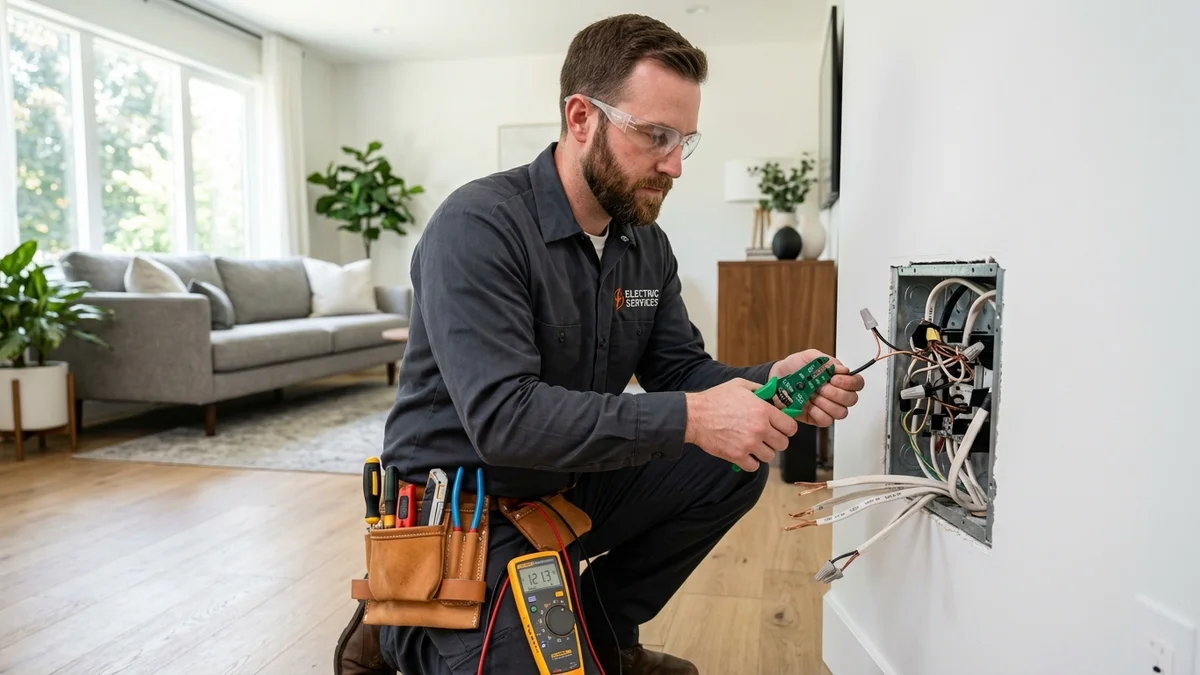
Reliable Electrical Diagnostics and Precision Repairs in Schenectady, NY
Every residential home and commercial facility relies on a complex network of concealed wiring, protective circuit breakers, switches, and receptacles. Over time, physical wear, environmental expansion and contraction, thermal cycling, and uncertified modifications can degrade electrical connections. When outlets stop working, lights flicker unpredictably, or switch plates feel unusually warm, ignoring these warning signs can compromise everyday convenience and introduce serious safety hazards.
Our regional dispatch network coordinates qualified, professional technicians specializing in comprehensive residential and commercial electrical services throughout Schenectady. Whether you need assistance diagnosing dead circuits in a historic Stockade brownstone, fixing an arcing breaker in a Bellevue bungalow, or repairing commercial branch wiring along the Upper Union Street business corridor, our network delivers reliable, long-lasting solutions.
We emphasize transparency from the initial call to project sign-off. Technicians conduct thorough diagnostic evaluations using calibrated testing instruments, explaining the root failure causes in plain language before presenting a clear written project estimate. Every service call strictly adheres to our clean-tech protocol: technicians wear protective shoe covers, place heavy drop cloths beneath work areas, and vacuum thoroughly before departing your property.
Common Electrical Malfunctions Diagnosed Across Schenectady Homes
Electrical problems in residential properties generally stem from loose connections, mechanical component degradation, or branch circuit overloads. Technicians routinely diagnose and resolve the following electrical issues across Schenectady, Rotterdam, and Scotia-Glenville:
| Common Electrical Problem | Physical Symptom Observed | Likely Underlying Cause | Recommended Professional Repair |
|---|---|---|---|
| Dead Wall Receptacles | One or more outlets in a room fail to deliver power; breaker remains on | Tripped GFCI upstream, backstabbed push-in wire failure, broken neutral splice | Circuit tracing, receptacle replacement, pigtailing screw-clamp connections |
| Flickering or Pulsing Lights | Fixtures flicker randomly or dim when large appliances start | High-resistance neutral connection, loose panel termination, failing dimmer switch | Panel lug torque verification, switch replacement, dedicated circuit addition |
| Warm or Discolored Switch Plates | Light switches or wall plates feel warm; brown scorching around slots | Loose terminal screws, undersized copper wiring, internal arcing within switch | Receptacle/switch replacement, wire re-stripping, terminal torquing to specification |
| Circuit Breakers That Trip Repeatedly | Breaker handle resets but snaps off immediately or trips under light use | Branch circuit overload, ground fault, pinched wire, internal breaker fatigue | Load calculation, insulation resistance testing, circuit breaker replacement |
| Sparks When Inserting Plugs | Visible blue flash or popping sound when appliance cord is inserted | Worn receptacle contact tension, short circuit within cord cap, loose device screws | Receptacle replacement with commercial-grade tamper-resistant outlet |
| Partial Power Loss (Half-House Outage) | Select 120V circuits and all 240V appliances (dryer, range) fail simultaneously | Burned main service lug, dropped utility phase conductor on overhead drop | Service entrance diagnostic, utility coordination with National Grid |
When sudden electrical faults create an imminent fire hazard or involve active smoke, property owners should immediately contact our dedicated emergency electrician dispatch service for prioritized response.
Technical Diagnostic Methodology
Accurate electrical repair requires structured diagnostic testing rather than guesswork. Attempting to resolve electrical faults by randomly replacing parts often masks serious underlying wire damage. Network technicians follow a rigorous diagnostic sequence:
1. Circuit Mapping and Verification
The technician identifies the specific circuit breaker controlling the malfunctioning branch, mapping all connected outlets, switches, and luminaires to calculate total connected load against breaker amperage capacity (15 amps or 20 amps).
2. Digital Multimeter Voltage Testing
Using true-RMS digital multimeters, the technician tests voltage across hot-to-neutral, hot-to-ground, and neutral-to-ground conductors. Standard 120-volt circuits should exhibit minimal voltage drop (less than 3% under load). High neutral-to-ground voltage indicates an open neutral or poor bonding connection that can damage sensitive electronics.
3. Insulation Resistance Testing (Megohmmeter Analysis)
When an intermittent short circuit or ground fault causes breakers to trip unpredictably, standard continuity meters may fail to detect faults. Technicians apply an insulation resistance tester (megger) to stress the conductor insulation with high test voltages (typically 500V DC). This empirical test exposes cracked, degraded, or moisture-damaged insulation concealed inside conduit or wall voids.
4. Infrared Thermal Scanning
Thermal cameras scan breaker bus bars, terminal lugs, and junction boxes under normal operational load. Hot spots with temperatures exceeding standard operating parameters (above 60°C or 75°C depending on wire rating) indicate loose connections or internal component degradation requiring immediate replacement.
5. Clear Written Estimate and Precision Repair
Following comprehensive testing, the technician presents a clear written estimate detailing the required repairs. For minor branch circuit fixes, work often proceeds immediately from fully stocked service vehicles. When diagnostic scans reveal extensive service panel degradation, the technician may recommend modernizing the service with an electrical panel upgrade.
Comparison of Common Electrical Repair Options
| Repair Scope | Typical Problem Addressed | Components Replaced or Installed | Expected Longevity | Code Compliance Impact |
|---|---|---|---|---|
| Branch Device Replacement | Cracked outlets, loose switches, worn contact tension | Commercial-grade tamper-resistant receptacles, heavy-duty switches | 15 to 25 Years | Meets modern NEC tamper-resistance and grounding standards |
| GFCI Safety Retrofit | Ungrounded two-prong outlets near water sources (kitchens, baths) | Class A Ground-Fault Circuit Interrupter receptacles with weather resistance | 10 to 15 Years (Self-Testing) | Satisfies NEC Article 406.4(D) for non-grounded replacement |
| Dedicated Appliance Circuit Run | Microwave, space heater, or refrigerator tripping shared bedroom breakers | 12/2 or 10/2 NM-B copper cable, dedicated 20A breaker, single receptacle | 30+ Years | Eliminates branch circuit overload, satisfies NEC dedicated circuit rules |
| Circuit Breaker Replacement | Breaker fails to reset, hums under normal load, or shows thermal wear | Brand-new OEM circuit breaker matched to panel manufacturer listing | 20 to 30 Years | Restores overcurrent and short-circuit protection |
| Junction Box Remediation | Flying splices outside enclosures, overcrowded boxes, deteriorated wire nuts | Metal or PVC junction boxes, UL-listed wire connectors, blank cover plates | Indefinite | Eliminates fire hazard from exposed splices; satisfies NEC 300.15 |
For property owners interested in understanding typical local pricing structures, our Schenectady electrician cost guide provides detailed hourly labor benchmarks and project pricing factors.
Schenectady Architecture and Specialized Repair Needs
The age of Schenectady’s residential properties plays a significant role in the types of electrical repairs required. In neighborhoods like the Stockade Historic District, homes often feature original plaster-and-lath walls concealing early knob and tube wiring. In these vintage properties, attempting DIY repairs can cause brittle, vulcanized rubber insulation to flake off the copper conductors, creating uninsulated bare wires inside wall cavities. When repairing circuits in historic properties, technicians utilize specialized non-invasive tools to fish new conductors without damaging architectural details. In homes with extensive knob and tube systems, property owners often transition from localized repairs to comprehensive whole-house rewiring.
In mid-century Schenectady neighborhoods such as Mont Pleasant, Woodlawn, and Goose Hill, homes constructed between 1950 and 1975 frequently feature legacy split-bus panels or early circuit breakers manufactured by Zinsco or Federal Pacific Electric. These vintage breakers frequently seize internally, failing to trip when a downstream short circuit occurs. When diagnosing recurring circuit problems in these homes, technicians evaluate whether individual breaker repair is technically viable or if complete panel modernization is required to ensure family safety and preserve property insurability.
Additionally, upstate New York winter freeze-thaw cycles create ground movement that can stress underground service lateral conduits, while roof ice dams can force meltwater into exterior meter sockets and wall penetrations. Technicians inspect weatherheads, silicone sealant collars, and service entrance cables to prevent water infiltration from corroding distribution equipment.
Safe Homeowner Troubleshooting vs. Hazards Requiring Professional Care
While homeowners can safely perform basic checks—such as verifying whether an appliance is plugged in or confirming if a bathroom GFCI reset button has tripped—attempting physical repairs on energized systems is dangerous.
- Safe Homeowner Action: Unplug appliances from a dead circuit, inspect appliance cords for visible fraying, and check if an upstream GFCI receptacle on the same circuit has tripped. If you want to understand why breakers trip, read our troubleshooting guide on why circuit breakers keep tripping.
- Dangerous Action Requiring Professional Service: Never remove the metal dead-front cover of an electrical panel. Even with the main breaker turned off, the incoming utility service lugs at the top of the panel remain energized with 240 volts of lethal electrical current. Never force a breaker handle to stay on with tape, and never replace a 15-amp breaker with a 20-amp breaker to prevent tripping, as this creates a severe fire hazard by allowing wires to carry current beyond their safe thermal capacity.
Frequently Asked Questions Regarding Electrical Repairs in Schenectady
Why do some outlets in my Schenectady home have no power while the breaker is on?
This common issue usually occurs when a GFCI outlet located upstream in a kitchen, bathroom, basement, or garage has tripped, cutting power to all downstream receptacles on that branch. Another frequent cause in older homes is backstabbed push-in terminal failure on an intermediate outlet. A technician can trace the circuit and repair the open splice.
Can an electrician convert two-prong outlets to grounded three-prong outlets without rewiring?
Yes. Under National Electrical Code Article 406.4(D), an ungrounded two-prong outlet can legally be replaced with a three-prong receptacle if it is protected by a Ground-Fault Circuit Interrupter (GFCI) and marked "No Equipment Ground." While this does not provide an equipment ground for surge protectors, it provides shock protection. Learn more in our outlet repair and installation guide.
Do small electrical repairs require a City of Schenectady building permit?
Routine maintenance—such as replacing broken switches, changing light fixtures, or swapping damaged receptacles with identical units—is generally exempt from municipal permitting. However, adding new branch circuits, running new Romex through walls, or altering service equipment requires a permit from the City of Schenectady Bureau of Code Enforcement.
What causes light switches to crackle or spark when turned on?
A crackling or buzzing sound inside a switch indicates internal arcing caused by worn mechanical contact points. Arcing generates intense localized heat that can ignite dust or wall framing inside the junction box. The switch should be turned off and replaced promptly by a qualified technician.
How are electrical repair services priced?
Service appointments begin with an on-site diagnostic evaluation to identify the root cause of the problem. Once diagnosed, the technician provides a clear written estimate detailing parts and labor prior to commencing work. Consult our pricing guide for local market benchmarks.
To schedule a reliable on-site diagnostic and electrical repair in Schenectady, call our direct field dispatch desk at (518) 490-0581 today.
Transparent Pricing and Diagnostic Disclosure
Estimates are for budgeting purposes only. Actual prices vary based on on-site conditions.
Project costs, diagnostic fees, and installation rates displayed or discussed are regional market estimates for Schenectady, NY and surrounding jurisdictions. Actual pricing varies based on exact site conditions, code compliance requirements, panel capacity, materials needed, and municipal permit parameters.
Every service call begins with a comprehensive on-site physical evaluation and a clear written estimate before any work commences. No surprise fees, hidden travel charges, or unapproved billings.