Quick Key Takeaways – Electrical Panel Upgrade
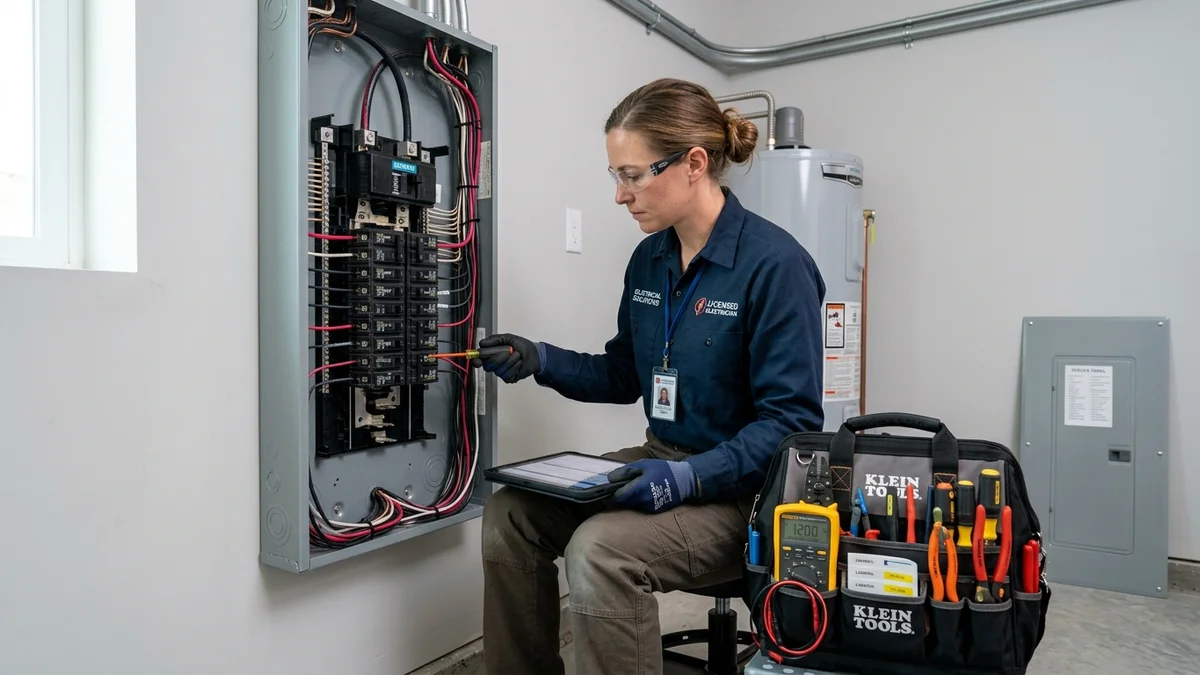
200-Amp Electrical Panel Upgrades and Service Modernization in Schenectady, NY
The main electrical service panel is the central nervous system of any residential home or commercial property. It receives high-voltage alternating current from the local electric utility and distributes it safely across branch circuits, protecting wiring from overloads and short circuits. However, thousands of residential structures throughout Schenectady were built decades ago when typical household electrical consumption was a fraction of today's demands. Outdated 60-amp and 100-amp distribution panels, obsolete fuse boxes, and historically problematic breaker enclosures routinely struggle to support modern central air conditioning, induction ranges, home heat pumps, and electric vehicle charging equipment.
Upgrading your electrical service to a modern 200-amp distribution center eliminates chronic breaker trips, improves electrical safety, meets current homeowner insurance requirements, and expands capacity for modern home additions. As an essential part of our complete residential and commercial electrical services, our network coordinates qualified, professional electrical contractors who specialize in comprehensive panel modernizations throughout Schenectady, Niskayuna, Rotterdam, and Scotia-Glenville.
Technicians manage every phase of the modernization process, including load calculation design, municipal permit acquisition through the City of Schenectady Bureau of Code Enforcement, coordination with National Grid for service disconnects, installation of brand-new 200-amp service entrance equipment, and independent electrical inspection certification.
Warning Signs That Your Schenectady Home Needs a Panel Upgrade
Many electrical service panels deteriorate silently over decades. Recognizing the warning signs of an overloaded or degraded panel helps homeowners take proactive action before catastrophic failures occur:
| Warning Symptom | Technical Failure Mechanism | Safety Risk Level | Recommended Corrective Action |
|---|---|---|---|
| Breakers Trip When Running Multiple Appliances | Total connected branch load exceeds bus bar capacity or main breaker rating | HIGH: Thermal fatigue on panel bus bars and main breaker | 200A service upgrade to expand total household ampacity |
| Panel Enclosure Hums, Buzzes, or Vibrates | Loose connection at main service lugs, arcing breaker stab, magnetic vibration | HIGH: Arcing fault can burn bus bar or ignite panel housing | Immediate emergency diagnostic and main breaker replacement |
| Warm Dead-Front Cover or Scorched Breakers | Excessive contact resistance caused by loose lugs or oxidized aluminum wiring | EXTREME: High thermal buildup inside panel cabinet | De-energize panel if safe; prompt emergency service required |
| Flickering Lights When Air Conditioning Starts | Severe voltage drop across undersized service entrance conductors | MODERATE: Voltage instability damages appliance electronics | Service entrance upgrade and conductor upsizing |
| Presence of a Legacy Screw-In Fuse Box | 60A service with screw-in Edison base fuses, prone to oversized pennies or wrong fuses | HIGH: Outdated technology incapable of supporting modern loads | Complete replacement with modern 200A circuit breaker load center |
| Federal Pacific Electric (FPE) or Zinsco Brand Panel | Documented failure to trip during sustained overcurrent; breakers fuse to bus | EXTREME: Proven fire hazard; frequent insurance disqualification | Immediate panel replacement with modern UL-listed equipment |
If your lights flicker frequently or you notice unusual odors near your electrical equipment, explore our educational guide on eight warning signs of electrical problems in older homes.
Dangerous Obsolete Panels Common in the Capital District
Schenectady’s housing stock features numerous homes constructed during the mid-20th century. During home sales and insurance renewals, property inspectors frequently flag two specific legacy panel brands:
Federal Pacific Electric (FPE) Stab-Lok Panels
Manufactured extensively between 1950 and the late 1980s, FPE Stab-Lok panels are widely installed in Schenectady neighborhoods such as Mont Pleasant, Bellevue, and Woodlawn. Extensive independent testing by forensic electrical engineers demonstrated that Stab-Lok breakers fail to trip under moderate overloads up to 60% of the time, and fail to trip under severe short circuits up to 25% of the time. When a breaker fails to trip, high amperage flows through branch wiring unchecked, overheating insulation and causing fires within wall framing. Many property insurance carriers in New York State will deny coverage or demand immediate replacement of FPE panels prior to issuing policies.
Zinsco and GTE-Sylvania Panels
Commonly installed during the 1970s, Zinsco panels feature aluminum bus bars that are highly prone to galvanic corrosion and oxidation. Over time, the breaker clips seize and weld themselves to the bus bar. Once welded, the breaker cannot trip mechanically, leaving the circuit completely unprotected. Removing a Zinsco breaker often pulls chunks of melted aluminum directly off the bus bar.
Replacing these dangerous obsolete units with a modern 200-amp Square D, Siemens, or Eaton load center restores verified overcurrent protection, brings your home into compliance with modern safety codes, and ensures full property insurability.
Detailed Step-by-Step Panel Upgrade Workflow
Upgrading an electrical panel is a sophisticated project involving high-voltage utility feeds, municipal permitting, and precise scheduling. Our network contractors execute panel upgrades through an organized four-phase process:
Phase 1: Load Calculation and Permitting
- Conducting full NEC Article 220 load calculations based on square footage, major appliances, and planned future loads (EV chargers, heat pumps).
- Pulling official electrical permits from the City of Schenectady Bureau of Code Enforcement.
- Submitting a formal service work order to National Grid for utility meter disconnect scheduling.

Phase 2: Service Entrance and Grounding Preparation
- Mounting a new exterior 200-amp lever-bypass meter pan on the building exterior.
- Installing rigid conduit or heavy-duty Schedule 80 PVC service mast through the roofline or to the utility overhead drop.
- Installing 2/0 copper or 4/0 aluminum Service Entrance (SE) conductors.
- Driving two 8-foot copper-clad grounding electrode rods spaced at least six feet apart into undisturbed earth, bonded with bare 4 AWG copper wire.
- Bonding the interior metallic water piping system and gas piping to the main grounding bus.

Phase 3: Panel Installation and Branch Circuit Cutover
- National Grid disconnects the overhead utility drop or underground lateral.
- Removing the obsolete panel cabinet and cleanly identifying all existing branch circuits.
- Installing the new 200-amp main distribution panel with integral main service disconnect.
- Installing modern Arc-Fault Circuit Interrupter (AFCI) and Ground-Fault Circuit Interrupter (GFCI) dual-function breakers compliant with NEC 2020.
- Neatly dressing, terminating, and labeling every branch circuit in the new panel schedule.

Phase 4: Inspection, Utility Reconnect, and Operational Clearance
- Certified third-party electrical inspection agency (e.g., NYEIA or MDIA) performs rigorous on-site evaluation.
- Inspector issues an official electrical certificate of compliance.
- National Grid re-energizes the service drop and sets the new electrical utility meter.
- Final operational testing of all household branch circuits and cleanup of the work area.
100-Amp vs. 200-Amp Electrical Service Comparison
| Feature or Capability | Typical 100-Amp Legacy Service | Modern 200-Amp Upgraded Service | Operational Impact |
|---|---|---|---|
| Total Available Power | 24,000 Watts (24 kW at 240V) | 48,000 Watts (48 kW at 240V) | 100% Increase in Total Household Capacity |
| Max Panel Breaker Spaces | 20 to 30 single-pole spaces | 40 to 60 full-size spaces | Eliminates need for dangerous tandem cheater breakers |
| Electric Vehicle Support | Highly limited; often requires load shedding | Dedicated 40A to 50A Level 2 EV charging circuit easily added | Seamless integration with EV charger installations |
| Heat Pump and AC Support | Can struggle with central heat pump + electric auxiliary heat | Fully capable of powering whole-home heat pump HVAC systems | Enables clean heating and cooling conversions |
| Backup Generator Ready | Difficult to add interlock without exceeding capacity | Ample space for manual interlock or automatic transfer switch | Seamless integration with backup generator installations |
| Surge Protection | Rare; lack of dedicated breaker spaces | Includes integrated Type 2 whole-home surge protective device | Full appliance protection via surge protection systems |
| Insurance Compliance | Often flagged by insurers during sales | 100% compliant with standard underwriting criteria | Preserves insurability and enhances property market value |
For transparent pricing benchmarks and itemized cost factor explanations, consult our comprehensive Schenectady electrical panel upgrade cost guide.
Municipal Codes and Third-Party Inspection Requirements in Schenectady
In the City of Schenectady, replacing an electrical service panel is strictly regulated under the New York State Uniform Fire Prevention and Building Code and local amendments codified in City Code Chapters 137 and 138. Homeowners should never hire unvetted handymen to perform service upgrades without permits. Doing so creates serious liability, risks utility disconnects, and will complicate future property sales.
All panel replacements coordinated through our dispatch network involve certified third-party inspection sign-offs. In Upstate New York, municipal code enforcement offices delegate electrical safety verification to approved independent inspection agencies, such as:
- New York Electrical Inspection Agency (NYEIA)
- Middle Department Inspection Agency (MDIA)
- The Inspector LLC
- Commonwealth Electrical Inspection Service
An authorized inspector visits the property, verifies grounding electrode impedance, checks conductor torque values with a calibrated torque wrench, confirms wire gauges, and ensures proper arc-fault protection before transmitting an official Certificate of Compliance to the City of Schenectady and National Grid.
Frequently Asked Questions Regarding Panel Upgrades
How long does a 200-amp panel upgrade take to complete?
The physical panel cutover typically takes 6 to 8 hours. The power is disconnected in the morning around 8:30 AM by National Grid, the technician installs the new equipment, the third-party electrical inspection is completed in the early afternoon, and National Grid re-energizes the service before the end of the business day.
Can I upgrade my panel to 200 amps if I still have older knob and tube wiring?
Yes. Technicians can upgrade the main electrical service panel to 200 amps while safely connecting existing knob and tube branch circuits using modern AFCI (Arc-Fault Circuit Interrupter) circuit breakers. However, homeowners are strongly advised to plan a phased whole-house rewiring project to permanently eliminate ungrounded wiring.
How much does an electrical panel upgrade cost in Schenectady?
Most 100-amp to 200-amp residential service upgrades in Schenectady range between $1,800 and $4,200, depending on whether the service drop is overhead or underground, if the meter pan must be relocated, and the length of the service entrance cable. Review our panel upgrade cost breakdown for detailed budgeting figures.
Will National Grid charge me a fee to disconnect and reconnect my service?
National Grid generally does not charge residential homeowners for standard disconnect and reconnect procedures during scheduled business hours when coordinated through a licensed permit process for routine upgrades.
Why does the 2020 National Electrical Code require an exterior emergency disconnect?
Under NEC Article 230.85, all new and upgraded residential electrical services must include an outdoor emergency disconnect switch accessible to first responders (firefighters) so power can be cut to the home during a fire without entering a smoke-filled building.
To schedule an on-site evaluation and receive an itemized, clear written estimate for your electrical panel upgrade in Schenectady, call our dispatch desk at (518) 490-0581 today.
Transparent Pricing and Diagnostic Disclosure
Estimates are for budgeting purposes only. Actual prices vary based on on-site conditions.
Project costs, diagnostic fees, and installation rates displayed or discussed are regional market estimates for Schenectady, NY and surrounding jurisdictions. Actual pricing varies based on exact site conditions, code compliance requirements, panel capacity, materials needed, and municipal permit parameters.
Every service call begins with a comprehensive on-site physical evaluation and a clear written estimate before any work commences. No surprise fees, hidden travel charges, or unapproved billings.