Quick Key Takeaways – Whole House Rewiring
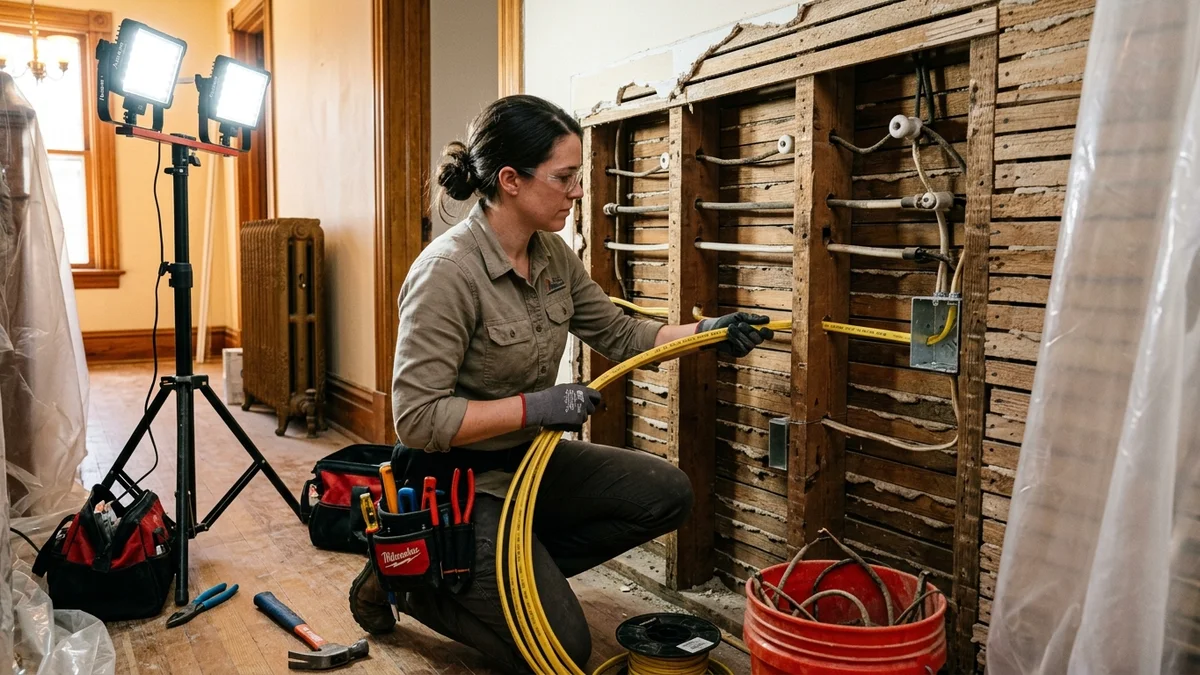
Comprehensive Whole-House Rewiring for Historic and Older Schenectady Residences
Schenectady is celebrated throughout New York State for its remarkable architectural heritage. From the pre-Revolutionary and Victorian homes of the Stockade Historic District to early 20th-century Craftsman bungalows in Bellevue and grand Revival estates in the GE Realty Plot, the city’s residential character is deeply historic. However, beneath the ornate plaster moldings, hand-carved millwork, and hardwood floors of these historic properties often lies outdated electrical wiring that was never engineered to handle the demands of modern 21st-century living.
Legacy electrical installations—most notably knob and tube wiring and ungrounded cloth-sheathed conductors—represent significant fire hazards and shock risks. As insulation deteriorates over decades, dry and brittle sheathing flakes away, exposing live copper conductors inside wall framing and attic spaces. Furthermore, ungrounded circuits leave expensive modern appliances, computers, and heating systems vulnerable to electrical damage.
Our regional dispatch network coordinates qualified, professional electrical contractors who specialize in non-invasive whole-house rewiring services tailored specifically to older and historic Schenectady homes. Technicians utilize advanced fishing tools, flexible drill bits, and borescope cameras to install modern grounded copper NM-B branch circuits while preserving irreplaceable historic plaster walls and vintage woodwork.
Whether you are completing a historic home restoration in Schenectady, upgrading wiring to secure homeowner insurance, or preparing to modernize your main electrical capacity with an electrical panel upgrade, our network delivers durable, code-compliant craftsmanship.
Hazards of Knob and Tube and Legacy Wiring Systems
Knob and tube wiring was the dominant residential electrical installation method in the United States from approximately 1880 through the 1940s. While technically sound when originally installed for modest lighting loads, the system presents severe hazards in contemporary households:
| Legacy Wiring Characteristic | Operational Limitation | Safety Hazard in Modern Homes |
|---|---|---|
| Complete Absence of Equipment Ground | Only two conductors (hot and neutral); zero grounding conductor | Severe shock risk; cannot ground three-prong appliances, surge protectors, or EVSE |
| Vulnerable Open-Air Heat Dissipation | Designed to dissipate heat into open wall cavities and uninsulated attics | Adding modern blown-in cellulose or fiberglass insulation traps heat, creating severe fire hazard |
| Deteriorated Organic Cotton/Rubber Sheathing | Vulcanized rubber insulation dries out, oxidizes, and crumbles under heat | Bare energized copper conductors contact framing lumber or metallic lath |
| Uncertified Splices and DIY Alterations | Previous owners frequently spliced modern Romex into knob and tube | Loose in-line solder connections overheat; causes hidden wall arcing |
| Undersized 15-Amp Branch Conductors | Wire gauge (often 14 AWG) inadequate for modern high-wattage appliances | Chronic thermal overload as modern families plug in space heaters, microwaves, and ACs |
Homeowners who notice discolored wall outlets or flickering lighting fixtures should review our educational guide on eight warning signs of electrical problems in older homes to assess their home's risk profile.
Non-Invasive Rewiring Methodology for Historic Architecture
Many homeowners delay necessary rewiring projects out of fear that contractors will tear down historic plaster walls and destroy vintage woodwork. Network technicians employ surgical, non-invasive wire fishing techniques engineered specifically for historic preservation:
Phase 1: Comprehensive Circuit Mapping and Architectural Assessment
- Tracing all existing branch circuits, switch legs, and receptacle feeds.
- Identifying balloon framing cavities, interior chases, and attic/basement pathways.
- Developing a customized wire fishing route that minimizes wall and ceiling penetrations.

Phase 2: Core Vertical Chases and Infrastructure Routing
- Utilizing continuous vertical wall cavities, abandoned chimney flues, and closet corners.
- Installing modern 200-amp capable Service Entrance conductors and dedicated subpanels.
- Running heavy-gauge copper home-run feeders from the basement main panel to upper floor distribution points.

Phase 3: Surgical Branch Circuit Fishing
- Using specialized flexible carbide drill bits and fiberglass wire pullers.
- Fishing modern grounded copper NM-B (Romex 12/2 and 14/2) through wall cavities from basement and attic access points.
- Cutting minimal, small circular access holes (2 to 4 inches) only where cross-blocking framing requires access.
- Installing modern deep plastic or metal old-work junction boxes secured directly to lath framing.

Phase 4: Device Termination, AFCI Protection, and Testing
- Installing modern commercial-grade tamper-resistant receptacles, switches, and dimmers.
- Connecting modern Arc-Fault Circuit Interrupter (AFCI) and Dual-Function AFCI/GFCI breakers.
- Verifying ground impedance and polarity at every newly installed receptacle.
- Complete vacuum cleanup and labeling of the newly modernized panel directory.
By prioritizing basement and attic access runs, technicians typically replace up to 90% of a home's wiring with only a handful of minor, easily repairable drywall or plaster penetrations.
Comparison of Partial Rewiring vs. Complete Whole-House Rewiring
| Comparison Factor | Targeted Partial Rewiring | Comprehensive Whole-House Rewiring |
|---|---|---|
| Primary Scope | Rewires high-draw areas (kitchen, bathrooms, laundry, HVAC) | Replaces 100% of legacy knob and tube and ungrounded wiring throughout property |
| Project Cost | Lower initial investment ($3,000 to $7,500 typical) | Comprehensive investment ($8,000 to $18,000+ depending on home square footage) |
| Safety Impact | Protects high-amperage circuits; leaves attic/bedroom knob and tube intact | Permanently eliminates fire and shock hazards from every room in the structure |
| Insurance Underwriting | May satisfy select carriers if knob and tube is certified non-active in attic | Fully satisfies all standard insurance carriers; guarantees complete insurability |
| Resale Property Value | Modest improvement; buyers may still negotiate electrical credits | Significant increase in market value, marketability, and buyer confidence |
| Integration with Upgrades | Supports targeted appliance additions | Easily supports EV charger installations and whole-home surge protection |
For detailed budgeting guidelines on labor rates and project pricing in Schenectady, consult our Schenectady electrician cost guide.
Historic Preservation Guidelines in Schenectady
Properties located within the City of Schenectady's designated historic districts—including the Stockade Historic District and the GE Realty Plot—are subject to local preservation guidelines overseen by the Schenectady Historic District Commission.
While interior electrical wiring alterations generally do not alter the exterior architectural fabric governed by preservation easements, contractors working within these districts must respect historic materials. Technicians take special precautions to:
- Avoid cutting original baseboards, decorative crown moldings, or period wood paneling.
- Preserve horsehair plaster and hand-split lath walls whenever practical.
- Install period-appropriate reproduction switch plates, push-button switches, or brass faceplates that match the home's historic aesthetic while incorporating modern UL-listed safety mechanisms.
- Coordinate with the City of Schenectady Bureau of Code Enforcement to pull electrical permits and schedule third-party electrical inspections (such as NYEIA or MDIA) compliant with the New York State Existing Building Code.
AFCI and GFCI Safety Integration During Rewiring
Under the 2020 National Electrical Code (NEC Article 210.12), all new branch circuits serving residential living rooms, bedrooms, dining rooms, hallways, and closets must be equipped with Arc-Fault Circuit Interrupter (AFCI) protection. AFCI circuit breakers detect dangerous low-level electrical arcing caused by damaged wire insulation, loose wire nuts, or cords pierced by furniture legs. By extinguishing arcs before temperatures reach the ignition point of framing lumber, AFCI breakers provide an essential safety layer in older wood-framed homes.
Similarly, all new receptacles installed in kitchens, bathrooms, unfinished basements, crawl spaces, and outdoor locations receive Ground-Fault Circuit Interrupter (GFCI) protection compliant with NEC Article 210.8, providing immediate shock protection in areas where moisture is present. Explore our full outlet repair and installation services for details on modern receptacle safety standards.
Frequently Asked Questions Regarding Whole-House Rewiring
Can I get homeowner insurance in Schenectady with active knob and tube wiring?
Most major property insurance carriers in New York State refuse to write new homeowner policies or charge exorbitant surcharges for properties with active knob and tube wiring. In many cases, carriers require a certified electrical contractor to inspect the home and verify that all knob and tube wiring has been decommissioned before underwriting coverage.
Will rewiring require tearing down my historic plaster walls?
No. Experienced contractors utilize surgical fishing techniques from basement and attic access points, fishing flexible Romex through existing wall voids with minimal disruption. In most rooms, no plaster is removed except for the small cutouts required for new electrical device boxes.
Can I live in my home while the rewiring is being completed?
Yes. Technicians execute whole-house rewiring in planned phases, typically addressing one floor or circuit zone at a time. Power is restored to essential living circuits at the end of each workday, allowing homeowners to remain in their homes comfortably throughout the project.
How long does a whole-house rewiring project take?
For an average 1,800 to 2,500 square-foot historic home in Schenectady, a complete rewiring project typically takes between 4 and 8 working days, depending on wall framing complexity, number of stories, and attic accessibility.
Do I need to upgrade my electrical panel when rewiring?
In most cases, yes. Historic homes with knob and tube wiring usually have older 60-amp or 100-amp panels that lack the physical breaker spaces required to support modern individual branch circuits. Combining rewiring with an electrical panel upgrade to 200 amps ensures comprehensive safety and modern capacity.
To schedule an on-site historic property assessment and receive an itemized, clear written estimate for whole-house rewiring in Schenectady, call our direct dispatch hotline at (518) 490-0581 today.
Transparent Pricing and Diagnostic Disclosure
Estimates are for budgeting purposes only. Actual prices vary based on on-site conditions.
Project costs, diagnostic fees, and installation rates displayed or discussed are regional market estimates for Schenectady, NY and surrounding jurisdictions. Actual pricing varies based on exact site conditions, code compliance requirements, panel capacity, materials needed, and municipal permit parameters.
Every service call begins with a comprehensive on-site physical evaluation and a clear written estimate before any work commences. No surprise fees, hidden travel charges, or unapproved billings.