Quick Key Takeaways – EV Charger Installation
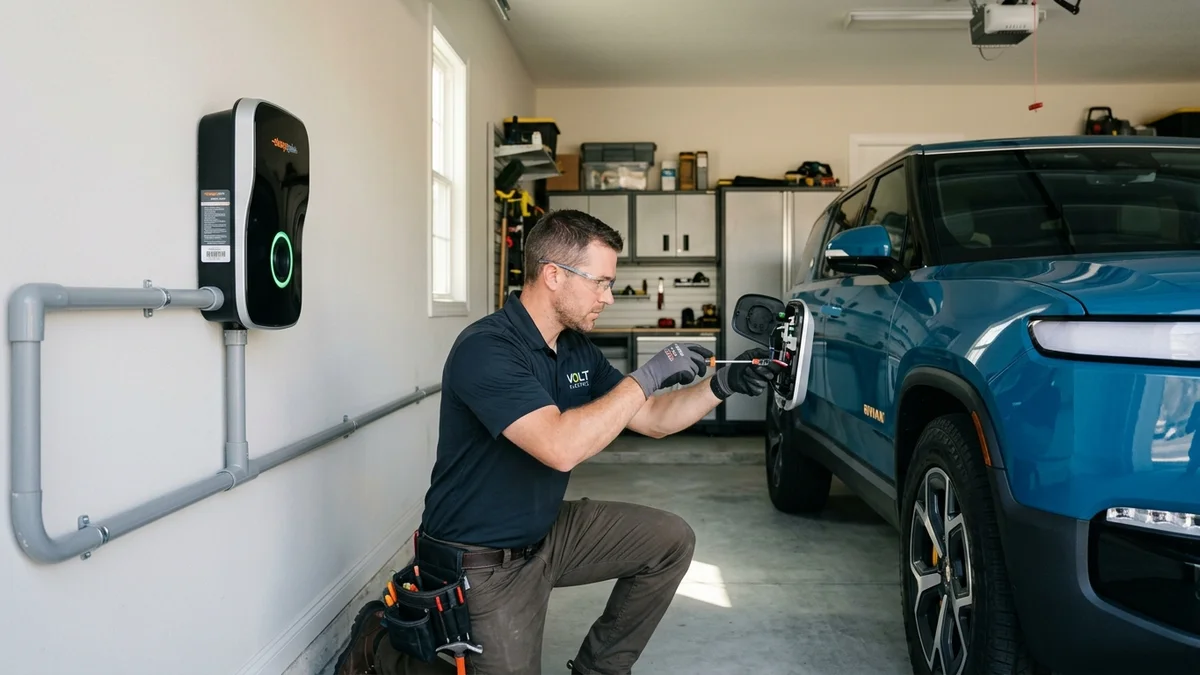
Residential Level 2 EV Charger Installations in Schenectady, NY
Electric vehicles (EVs) have transitioned from niche technology to mainstream transportation across New York State. Automakers including Tesla, Ford, Chevrolet, Hyundai, Rivian, and BMW now offer high-range electric vehicles capable of traveling 250 to 350 miles on a single charge. However, the convenience of EV ownership relies heavily on fast, dependable overnight home charging. Relying on a standard 120-volt household wall outlet (Level 1 charging) can require 24 to 40 hours to replenish a modern battery pack, adding only 3 to 5 miles of range per hour of charging.
A professionally installed dedicated 240-volt Level 2 Electric Vehicle Supply Equipment (EVSE) charging station transforms your charging experience, delivering 25 to 45 miles of range per hour of charging. A standard overnight charging session of 6 to 8 hours fully charges your vehicle, ensuring complete battery range for your daily commute through Schenectady and the Capital District.
Our regional dispatch network coordinates qualified, professional electrical contractors specializing in residential EV charger installations throughout Schenectady, Niskayuna, Rotterdam, and Scotia-Glenville. Technicians perform detailed NEC Article 220 load calculations on your existing service panel, install heavy-duty 240V dedicated branch circuits, mount and wire your preferred charging hardware, and secure required municipal permits through the City of Schenectady Bureau of Code Enforcement.
If your electrical panel lacks available breaker spaces or total amperage capacity to support a high-draw 40-amp or 50-amp continuous charging load, technicians seamlessly combine your charging setup with a comprehensive electrical panel upgrade to 200 amps.
Level 1 vs. Level 2 EV Home Charging Comparison
| Charging Specification | Standard Level 1 Charging (120V) | Dedicated Level 2 Charging (240V) |
|---|---|---|
| Voltage and Circuit Requirements | Standard 120-volt, 15A or 20A household outlet | Dedicated 240-volt, 40A to 60A branch circuit |
| Charging Speed (Miles of Range Added) | 3 to 5 Miles per Hour of Charging | 25 to 45 Miles per Hour of Charging |
| Full Battery Replenishment Time (75 kWh) | 24 to 40+ Hours | 6 to 9 Hours (Full Overnight Replenishment) |
| Electrical Safety Protection | Standard branch breaker, shared with garage/exterior outlets | Dedicated double-pole breaker with GFCI protection |
| Cold Weather Performance | Substantially reduced speed in Upstate NY sub-zero winters | High thermal efficiency; preconditions cabin while plugged in |
| Utility Rebate Eligibility | Ineligible for state and utility incentives | Eligible for NYSERDA Drive Clean and utility incentive programs |
In upstate New York, winter temperatures regularly dip below freezing. In extreme cold, electric vehicle battery management systems divert substantial electrical power simply to heat battery cells to operational temperatures before charging can commence. On a 120-volt Level 1 cord, almost the entire electrical output can be consumed by the battery heater, leaving virtually zero energy to increase battery state-of-charge. A 240-volt Level 2 installation delivers the amperage required to heat the battery and replenish vehicle range efficiently throughout severe winter freezes.
Electrical Load Calculations: Assessing Your Schenectady Home Panel Capacity
The National Electrical Code (NEC Article 625) classifies electric vehicle supply equipment as a continuous load, defined as an electrical load where the maximum current is sustained for three hours or more. Under national electrical safety rules, continuous loads must not exceed 80% of the branch circuit breaker’s rated capacity:
- A 32-amp EV charger requires a minimum 40-amp dedicated circuit breaker.
- A 40-amp EV charger requires a minimum 50-amp dedicated circuit breaker.
- A 48-amp EV charger (such as a hardwired Tesla Wall Connector) requires a minimum 60-amp dedicated circuit breaker.
Before installing an EV charger, a qualified technician conducts an empirical load calculation to determine whether your existing main electrical service panel can support an additional 40A to 60A continuous load.
Many older homes in Schenectady neighborhoods such as the Stockade, Bellevue, and Mont Pleasant remain on older 100-amp main services. If your home operates a 100-amp panel alongside an electric clothes dryer (30A), electric range (40A), and central air conditioning compressor (30A), adding a 40A continuous EV load can overload the main bus bar and main breaker. In these scenarios, the technician will present options such as:
- Executing a 200-amp service entrance upgrade through our electrical panel upgrade service.
- Installing an intelligent smart energy management system (load shedding monitor) that pauses vehicle charging if other heavy household appliances engage simultaneously.
Hardwired Charging Units vs. 240-Volt NEMA 14-50 Receptacles
When designing your residential EV charging installation, you can select between two primary configurations:
| Installation Method | Hardwired EV Charging Station | 240V NEMA 14-50 Plug-In Receptacle |
|---|---|---|
| Maximum Amperage Delivery | Up to 48 Amps (on a dedicated 60A circuit) | Limited to 40 Amps (on a dedicated 50A circuit) |
| Maximum Charging Speed | Adds up to 45 miles of range per hour | Adds up to 35 miles of range per hour |
| GFCI Breaker Requirement | Standard breaker permissible (charger has internal GFCI) | Requires GFCI breaker under NEC 2020 Article 210.8(A) |
| Weather and Outdoor Durability | Highly weather-resistant; sealed NEMA 3R/4 enclosure | Requires heavy-duty weather-resistant in-use bubble box |
| Hardware Portability | Permanent fixture; requires electrician to disconnect | Easy to unplug and transport mobile charging cable |
| Popular Hardware Compatible | Tesla Wall Connector, ChargePoint Home Flex (hardwired) | Mobile charging cords, JuiceBox 40, Grizzl-E Plug-in |
Technicians guide property owners in selecting the optimal configuration based on garage layout, vehicle specifications, and budget. Commercial-grade industrial receptacles (such as Bryant or Hubbell 14-50 outlets) are utilized for plug-in installations to prevent terminal melting associated with lower-cost builder-grade dryer outlets.
Step-by-Step EV Charger Installation Workflow
Technicians follow a standardized four-phase installation sequence engineered for safety, code compliance, and clean aesthetics:
Phase 1: On-Site Site Assessment and Load Calculation
- Inspecting existing distribution panel, available breaker spaces, and main service amperage.
- Performing formal NEC Article 220 demand calculations to verify electrical capacity.
- Reviewing garage or driveway mounting location to optimize vehicle charging port reach.

Phase 2: Conduit and Conductor Installation
- Running heavy-duty 6 AWG copper conductor (for 50A circuits) or 4 AWG copper (for 60A circuits).
- Installing neat, surface-mounted Electrical Metallic Tubing (EMT) or concealed interior Romex.
- Installing a double-pole circuit breaker matched to your charging equipment specifications.

Phase 3: Station Mounting and Electrical Termination
- Mounting the charging unit or commercial-grade NEMA 14-50 outlet box securely to framing.
- Torquing all wire lugs to manufacturer specifications using calibrated torque screwdrivers.
- Configuring internal DIP switches or Wi-Fi commissioning apps for correct amperage limits.

Phase 4: Operational Commissioning and Safety Testing
- Performing ground fault loop impedance testing and voltage drop verification.
- Connecting the charging station to the vehicle to confirm active charging handshake.
- Scheduling municipal electrical inspection sign-off through certified third-party agencies.
To protect your expensive electric vehicle and sensitive charging hardware from utility grid spikes and seasonal lightning storms, technicians frequently recommend pairing your installation with whole-home surge protection.
New York State Rebates, Incentives, and Permitting in Schenectady
Installing an EV charger in Schenectady qualifies homeowners for attractive state, federal, and utility incentive programs:
- Federal Inflation Reduction Act (Section 30C Credit): Provides a federal tax credit covering up to 30% of the cost of EV charger hardware and installation in qualifying geographic tracts.
- National Grid EV Make-Ready Program: Upstate New York electric utility National Grid offers residential managed charging programs that provide bill credits for off-peak overnight vehicle charging.
- NYSERDA Clean Energy Programs: State-sponsored initiatives frequently provide additional rebate opportunities for energy-efficient residential charging infrastructure.
Under City of Schenectady Code Chapter 138, installing a new 240-volt branch circuit for vehicle charging requires an official electrical permit. Network contractors handle the complete permitting workflow with the City of Schenectady Bureau of Code Enforcement and coordinate certified third-party inspections through approved agencies (such as NYEIA or MDIA) to ensure code compliance.
Frequently Asked Questions Regarding EV Charger Installation
Can my 100-amp electrical panel support a Level 2 EV charger?
In some smaller homes with gas heating, a gas range, and a gas water heater, a 100-amp panel may have sufficient remaining capacity to support a 32-amp EV charger (40A breaker). However, if your home utilizes all-electric appliances or central air conditioning, an electrical panel upgrade to 200 amps or an intelligent load-shedding device is typically required.
How much does it cost to install an EV charger in Schenectady?
Standard residential EV charger installations in Schenectady typically range from $750 to $1,800 for the electrical installation and permit (excluding the cost of the charging unit itself). Costs vary depending on the distance between your electrical panel and the garage mounting location. Review our Schenectady electrician cost guide for budgeting factors.
What is the difference between a 40-amp and a 50-amp EV charger circuit?
A 40-amp circuit allows the vehicle to draw 32 amps continuously (approx. 7.7 kW), adding roughly 25 to 30 miles of range per hour. A 50-amp circuit allows the vehicle to draw 40 amps continuously (approx. 9.6 kW), adding 32 to 38 miles of range per hour.
Can an EV charger be installed outdoors if I do not have a garage?
Yes. Technicians install weather-rated NEMA 3R or NEMA 4 outdoor-rated charging stations mounted on exterior home siding or dedicated outdoor pedestals, complete with weather-resistant conduit and in-use protective covers.
Do technicians install Tesla Wall Connectors as well as universal chargers?
Yes. Technicians install all major brand chargers, including the Tesla Wall Connector, ChargePoint Home Flex, Emporia EV Charger, Grizzl-E, JuiceBox, and Ford Connected Charge Station.
To schedule an on-site EV charger assessment and receive an itemized, clear written estimate in Schenectady, call our direct field dispatch desk at (518) 490-0581 today.
Transparent Pricing and Diagnostic Disclosure
Estimates are for budgeting purposes only. Actual prices vary based on on-site conditions.
Project costs, diagnostic fees, and installation rates displayed or discussed are regional market estimates for Schenectady, NY and surrounding jurisdictions. Actual pricing varies based on exact site conditions, code compliance requirements, panel capacity, materials needed, and municipal permit parameters.
Every service call begins with a comprehensive on-site physical evaluation and a clear written estimate before any work commences. No surprise fees, hidden travel charges, or unapproved billings.