Quick Key Takeaways – Whole Home Surge Protection
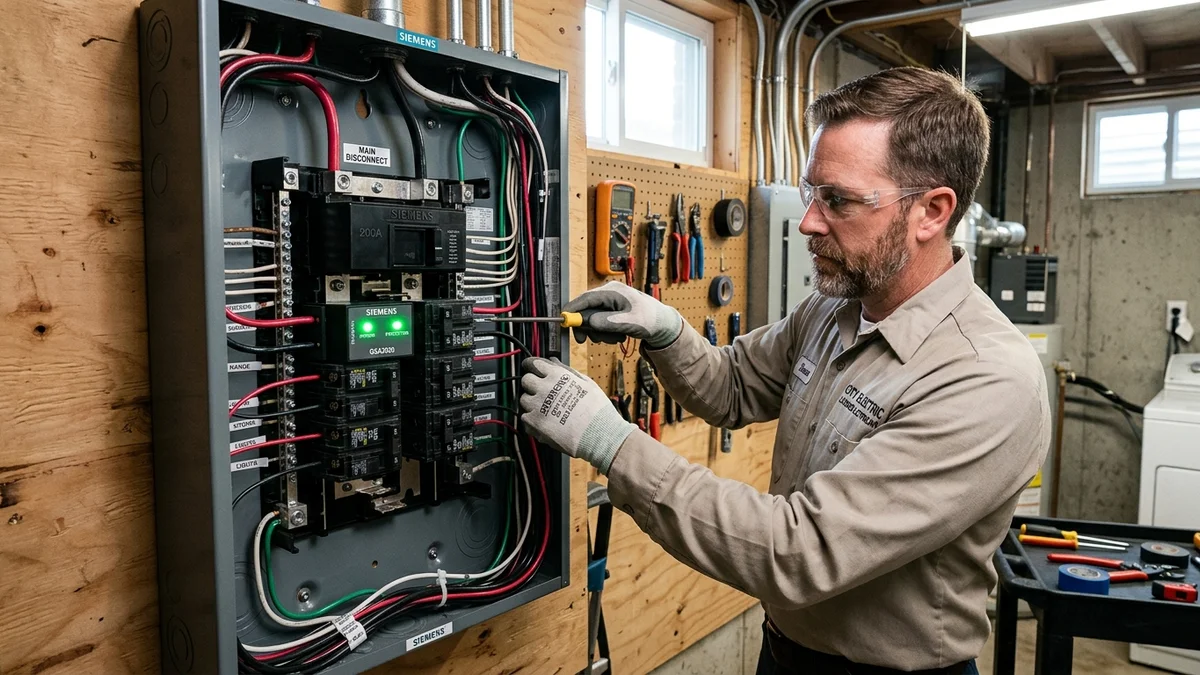
Comprehensive Whole-Home Surge Protection Solutions in Schenectady, NY
Modern residential homes and commercial buildings contain tens of thousands of dollars worth of microprocessor-driven technology. Smart refrigerators, variable-speed heat pump compressors, high-efficiency boilers, home entertainment systems, EV charging stations, and smart home automation hubs all depend on delicate solid-state microchips. These microprocessors operate at low DC voltages (often 3.3 to 5 volts DC) and are highly vulnerable to electrical transient overvoltages—commonly known as electrical surges.
While many property owners rely on inexpensive plug-in power strip surge protectors, standard power strips provide only localized, limited defense. Power strips cannot protect hardwired major appliances, such as your heating system, central air conditioning, well pumps, or wall ovens. Furthermore, power strips degrade silently over time without alerting homeowners that their internal protective components have failed.
Our regional dispatch network coordinates qualified, professional electrical contractors who specialize in comprehensive whole-home surge protection installations throughout Schenectady, Rotterdam, Niskayuna, and Scotia-Glenville. Technicians install heavy-duty, panel-mounted Type 1 and Type 2 Surge Protective Devices (SPDs) compliant with UL 1449 standards, clamping destructive voltage spikes directly at your main service distribution center before they enter your living spaces.
If your property operates an older electrical panel with limited breaker space, technicians can combine surge protection with an electrical panel upgrade to 200 amps.
Where Do Electrical Surges Originate?
A widespread misconception among homeowners is that electrical surges are caused exclusively by direct lightning strikes. In reality, lightning accounts for less than 20% of residential surge events:
| Surge Origin | Specific Cause Mechanism | Frequency of Occurrence | Potential Damage Impact |
|---|---|---|---|
| Internal Household Cycling (80% of Surges) | Motors in air conditioners, refrigerators, heat pumps, and power tools cycling on/off | Hundreds of times daily inside your own home | Gradual, cumulative degradation of microprocessors ("electronic rust") |
| Utility Grid Switching and Grid Faults | National Grid line switching, substation capacitor bank adjustments, grid load transfers | Daily to weekly utility events across the Capital District | Moderate to high voltage spikes (500V to 3,000V) affecting whole neighborhoods |
| Downed Power Lines and Vehicle Accidents | Cars striking utility poles, falling tree limbs during Mohawk Valley winter storms | Occasional seasonal events | Severe sustained overvoltage; can blow out multiple appliances instantly |
| Atmospheric Lightning Strikes | Cloud-to-ground lightning strikes hitting nearby power lines or utility transformers | Seasonal summer storms across Upstate New York | Extreme transient energy (thousands of amps); catastrophic fire and blowout risk |
While an extreme external surge can destroy an appliance instantly, the repetitive daily internal surges generated by large motors slowly degrade sensitive circuit boards over months or years. Homeowners often attribute early appliance breakdowns to poor equipment quality when chronic electrical transient damage was the true culprit.
The Three-Tier Surge Protection Architecture (NEMA Standards)
Under National Electrical Manufacturers Association (NEMA) guidelines, complete property defense requires a coordinated, multi-tier surge suppression strategy:
The Cascaded 3-Tier Surge Defense Strategy:
[Utility Power Grid]
       │
       ▼
[Tier 1: Type 1 SPD] ---> Mounted between utility transformer and main service disconnect (External Defense)
       │
       ▼
[Tier 2: Type 2 SPD] ---> Mounted directly at the main breaker panel bus bar (Whole-Home Defense)
       │
       ▼
[Tier 3: Type 3 SPD] ---> Point-of-use plug-in surge strips for sensitive electronics (Localized Clamping)
Type 1 Surge Protective Devices
Installed between the secondary side of the utility service transformer and the line side of your main service disconnect (often at the exterior meter base). Type 1 SPDs protect against large external surges from lightning strikes and utility line events.
Type 2 Surge Protective Devices (Standard Whole-Home Unit)
Mounted directly to your main electrical panel cabinet and connected via a dedicated double-pole 20A or 30A circuit breaker. Type 2 SPDs clamp residual external surges and internally generated surges at the central bus bar, protecting all branch circuits, hardwired appliances, and lighting throughout the entire home.
Type 3 Surge Protective Devices
Point-of-use plug-in surge protector power strips positioned at individual wall outlets. Type 3 devices provide the final buffer for ultra-sensitive electronics, such as gaming consoles, audio gear, and desktop computers.
By deploying a Type 2 panel-mounted unit alongside Type 3 point-of-use protectors, homeowners achieve an impenetrable, cascaded defense system.
Technical Specifications: What Makes a Quality Surge Protector?
When selecting and installing a whole-home surge protective device, technicians evaluate several technical metrics to ensure maximum protection:
| Technical Specification | What the Metric Measures | Recommended Benchmark for Schenectady Homes |
|---|---|---|
| Surge Current Capacity (kA Rating) | The maximum peak surge current (in kiloamps) the SPD can safely divert to ground in a single pulse | 50,000 to 100,000 Amps (50 kA to 100 kA) per phase |
| Voltage Protection Rating (VPR) | The maximum "let-through" voltage the SPD permits to pass into household circuits before clamping | 600V to 800V L-N (Lower VPR indicates superior protection) |
| Short-Circuit Current Rating (SCCR) | The maximum prospective short-circuit current the device can withstand without exploding | 22,000 to 100,000 Amps (22 kA to 100 kA SCCR) |
| Maximum Continuous Operating Voltage (MCOV) | The maximum voltage the device can sustain continuously without degrading | 150V L-N for standard 120V circuits; 300V L-L for 240V circuits |
| Safety Certification Standard | Verification of independent laboratory testing under severe electrical conditions | UL 1449 4th Edition Listed |
| Active Status Indicator System | Visual LEDs and audible alarms notifying homeowners of device status | Dual-stage LED operational monitoring with audible fault alarm |
Technicians exclusively install commercial-grade Type 2 SPDs manufactured by reputable brands including Square D, Eaton, Siemens, and Intermatic, complete with manufacturer equipment protection warranties.
2020 National Electrical Code (NEC) Surge Protection Mandate
Surge protection is no longer merely a recommended luxury. Under the 2020 National Electrical Code (NEC Article 242.08):
"All electrical services supplying dwelling units shall be provided with a surge-protective device (SPD). The SPD shall be an integral part of the service equipment or shall be located immediately adjacent to the service equipment."
This means that whenever an electrical service is newly constructed or upgraded in the City of Schenectady—such as converting a 100-amp panel to a 200-amp panel—the City of Schenectady Bureau of Code Enforcement legally mandates the installation of a Type 1 or Type 2 surge protective device. Installing whole-home surge suppression guarantees that your property complies with modern municipal code standards.
If your home’s existing panel is full or experiencing breaker trips, explore our electrical repair services to assess your panel configuration.
Step-by-Step Surge Protector Installation Workflow
Installing a panel-mounted surge protective device requires direct work inside your main distribution cabinet. Technicians execute installations using an exact protocol:
Step 01: Panel Inspection and Capacity Verification
- Verifying the presence of an available double-pole breaker space immediately adjacent to the main breaker.
- Inspecting the grounding electrode system (ground rods and water pipe bond) to verify low-impedance ground path.

Step 02: Mounting and Conductor Trimming
- Mounting the SPD enclosure directly to the panel cabinet knockout using rigid nipples.
- Trimming the SPD leads (hot, neutral, ground) as short and straight as possible (under 12 inches) to minimize wire inductance.

Step 03: Breaker Termination and Torquing
- Terminating the two ungrounded leads to a new dedicated double-pole 20A or 30A breaker.
- Securing neutral and ground leads to the respective panel bus bars using calibrated torque screwdrivers.

Step 04: Commissioning and Operational Verification
- Energizing the breaker and verifying green diagnostic LED status indicators.
- Documenting serial numbers and completing the manufacturer's connected equipment warranty registration.
Whole-home surge protection provides essential protection for homeowners investing in high-value electrical modernizations, such as Level 2 EV charger installations or backup generator systems.
Frequently Asked Questions Regarding Whole-Home Surge Protection
Will a whole-home surge protector prevent damage from a direct lightning strike?
No electrical device can guarantee protection against a direct lightning strike carrying millions of volts and hundreds of thousands of amps directly into a structure. However, whole-home SPDs provide robust defense against secondary lightning strikes (strikes hitting nearby ground or utility distribution lines miles away), which represent the vast majority of storm-related surge events in Upstate New York.
Do I still need power strip surge protectors if I have a whole-home unit?
Yes. A cascaded defense strategy is recommended. The whole-home Type 2 SPD at your panel clamps high-energy utility surges, while Type 3 plug-in strips at individual wall outlets buffer sensitive electronics from minor localized voltage transients.
How do I know if my surge protector has sacrificed itself?
Quality Type 2 surge protective devices feature visual diagnostic LEDs. When the green LED is illuminated, the internal metal-oxide varistors (MOVs) are active. If a massive surge occurs and the unit sacrifices itself to protect your home, the LED will extinguish or turn red, and an audible alarm may sound, signaling that the device requires replacement.
Can a surge protector be installed on any electrical panel?
Yes, provided there are two adjacent breaker slots available to install a dedicated double-pole breaker. If your panel is completely full, a technician can install tandem breakers or evaluate an electrical panel upgrade to create required space.
How much does it cost to install a whole-home surge protector in Schenectady?
Most residential Type 2 panel-mounted surge protector installations in Schenectady range between $350 and $650, including the commercial-grade UL 1449 device, dedicated breaker, conduit mounting hardware, and certified labor. Review our panel upgrade cost guide for budgeting factors.
To protect your home’s electronic infrastructure with an itemized, clear written estimate in Schenectady, call our direct field dispatch desk at (518) 490-0581 today.
Transparent Pricing and Diagnostic Disclosure
Estimates are for budgeting purposes only. Actual prices vary based on on-site conditions.
Project costs, diagnostic fees, and installation rates displayed or discussed are regional market estimates for Schenectady, NY and surrounding jurisdictions. Actual pricing varies based on exact site conditions, code compliance requirements, panel capacity, materials needed, and municipal permit parameters.
Every service call begins with a comprehensive on-site physical evaluation and a clear written estimate before any work commences. No surprise fees, hidden travel charges, or unapproved billings.